Two-arm grasping, commercial reuse: which open models to start from
Sample selection report, short version · Starfind AI · checked 30 October 2026, updated 11 November 2026, licences re-checked 21 November 2026 · check again by 21 December 2026
The question: "We are preparing a two-arm grasping demo and want to keep using it in commercial projects. Which open models should we start from?" This is a sample: the requirements are illustrative, not a real client's. Starfind AI did not run the models; results are as published by the named evaluators. Terms are what each artifact's own licence file declares, or its licence field where it has none; README text and model cards are not treated as terms. This is not legal advice, and no model below is described as safe for commercial use: that is a question for your counsel.
Short answer
| Start from | Two-arm evidence (who measured it, trials, source) | Commercial use as declared: code / weights / training data |
|---|---|---|
| MolmoAct2 (Ai2) | Its authors: bimanual i2RT YAM, 8 tasks × 50 trials, 50.6% average success (MolmoAct2 paper, Table 19) | Permitted / permitted, but stated only in the code README / permitted |
| RDT-1B (Tsinghua) | Its authors: AgileX Mobile ALOHA, 7 tasks, 8 to 25 trials each, 40% to 100% success (RDT paper, Table 3). Independent: ALOHA, 4 tasks, staged score 44 to 100 (OpenVLA-OFT paper) | Permitted / permitted / unclear |
| π0 (Physical Intelligence), as a benchmark | Independent: ALOHA, 4 tasks, staged score 42 to 100; ahead of RDT-1B on 2 tasks, tied on 1, 2 points behind on 1 (OpenVLA-OFT paper) | Permitted / unclear: the checkpoints carry no licence / unclear |
| OpenVLA-OFT+ recipe on OpenVLA 7B | Its authors: ALOHA, staged score 51 to 100, best in its paper. Independent: YAM, 8 tasks × 50 trials, 35.5% average (MolmoAct2 paper) | Permitted / permitted, with Llama 2 terms / unclear |
Set aside for this project: GR00T N1.5 and N1.6, whose weights ship with NVIDIA's non-commercial licence file, and GR00T N1.7, whose weights moved to the NVIDIA Open Model License on 10 November 2026 but which has no published two-arm number from NVIDIA; AgiBot GO-1, with no licence file and non-commercial terms in its own texts; π0.5, with no licence for its checkpoint; X-VLA, whose one independent two-arm result is 4.9% average success on the YAM (8 tasks × 50 trials, lowest of five), while its authors' cloth-folding result has no published trial count; SmolVLA, open and light but with single-arm evidence only. Watch LingBot-VLA 4B: its authors report 15.5% success on 100 two-arm tasks on AgileX (15 trials each), but its weights carry no licence yet.
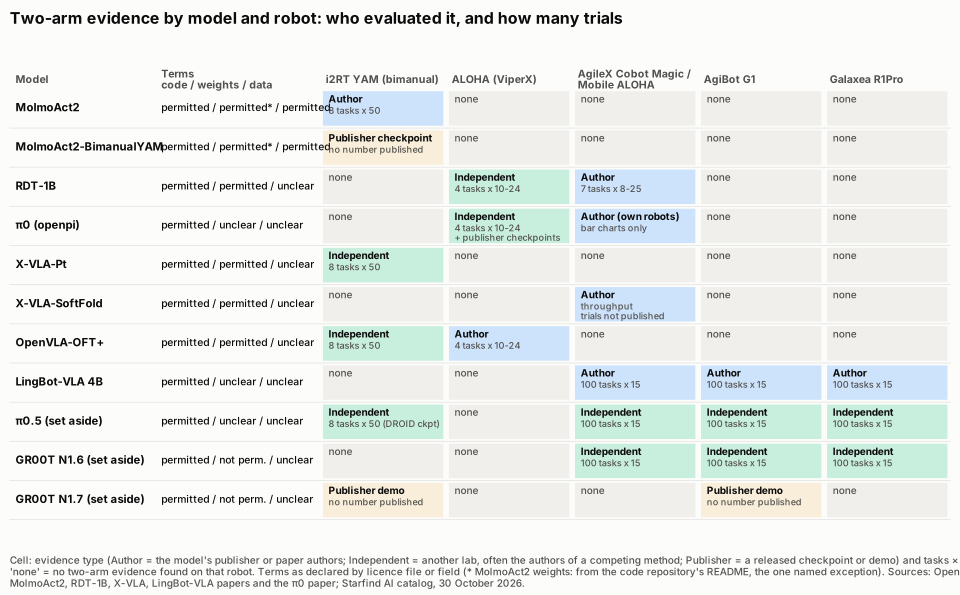
Who measured each model on which two-arm robot, and with how many trials. "none" means no two-arm evidence was found there. Sources: the models' papers; Starfind AI catalog, 30 October 2026.
Three things that trip teams up
- The code licence is not the weights licence, and the weights licence is not the data's. GR00T N1.5's code is Apache 2.0 while its weights are research-only. Three of the four models above permit commercial use of their weights as declared, yet none but MolmoAct2 has training data whose terms are all declared.
- "ALOHA" is not one robot. Results in these sources come from the original Stanford station (ViperX arms), AgileX's Cobot Mobile ALOHA (7-DoF arms), AgileX's Piper-based platform and, for MolmoAct2, i2RT's YAM. A checkpoint for one needs new data and fine-tuning on another.
- A score is not a success rate, and a few trials prove little. The one head-to-head two-arm comparison reports staged scores out of 100 over 10 to 24 trials, with every model fine-tuned per task and evaluated by the authors of one of them. On the hardest task (put an object in a pot, 300 demonstrations) the best score was 51 of 100, and the top three finished the task in 6 to 7 of 24 trials each.
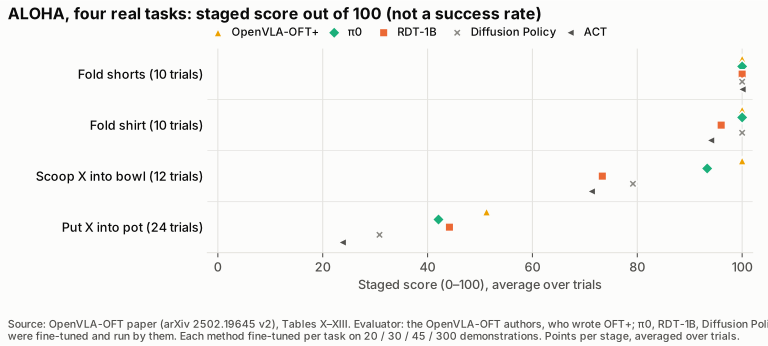
Staged score out of 100, not a success rate. Source: OpenVLA-OFT paper (arXiv 2502.19645 v2), Tables X–XIII; evaluator: the OpenVLA-OFT authors, who wrote OFT+ and ran the other four. Trials per task in brackets.
What the full report adds
- Exact versions pinned to repository revisions, and for code, weights and training data the source each term comes from, which dataset decides, and the questions for counsel on each.
- Every hardware result with its robot configuration, task, trial count, metric and evaluator, as charts with the numbers beside them, and how much each rate can be trusted given its trials.
- A two-to-three-week validation plan: which two models to fine-tune on the same data, the evaluation protocol, and what would change the choice.
- Sources for every fact, with check dates, and a check-by date.
Want the full report?
The full version of this sample adds pinned versions, every hardware result with its trial count and evaluator, and a validation plan. Email info@starfindai.com with the subject “Full sample report” and we will send it.